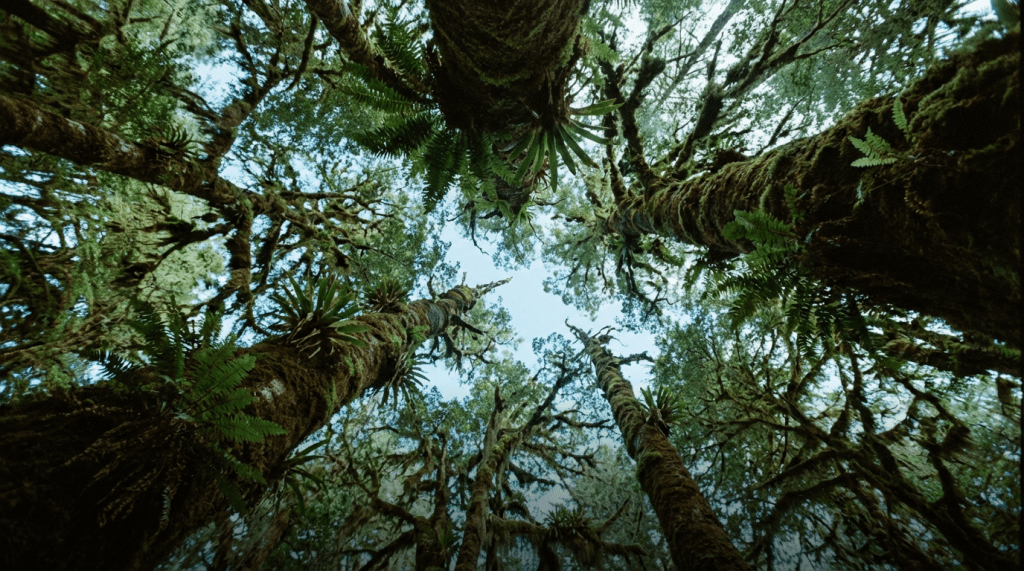

This is the second in a series of five articles, each one expanding on a principle from Five Practices for a Life Aligned with Nature, where I laid out the five roots of my Purely Rooted philosophy. This article goes deeper on the second: Step Outside, Into Green.
Trees release invisible chemical compounds called phytoncides into the air. These volatile organic molecules evolved as a defense mechanism, protecting trees from insects, bacteria, and fungi. When you walk through a forest and breathe deeply, you inhale these compounds. And something remarkable happens inside your body: your immune system wakes up.
This isn’t folk wisdom or a wellness trend. It’s measurable biology, studied in controlled settings and published in peer-reviewed journals for more than two decades. The Japanese practice of shinrin-yoku (forest bathing) has generated an entire field of research, and the results keep pointing in the same direction: time in forests doesn’t just feel good. It changes your body chemistry in ways that protect against disease.
How Trees Boost Your Immune System
Dr. Qing Li, a professor at Nippon Medical School in Tokyo, has spent over 20 years studying what happens when humans spend time among trees. His research has consistently shown that forest environments increase the activity and number of natural killer (NK) cells, a type of white blood cell that detects and destroys virus-infected cells and tumor cells.
In one study, published in 2008, female subjects who took a three-day, two-night forest bathing trip showed a significant increase in NK cell activity, along with increased expression of three anti-cancer proteins: perforin, granzyme A, and granulysin. The immune boost lasted for more than seven days after leaving the forest. A companion study comparing forest visits to city visits confirmed that the effect was specific to forest environments; urban walks produced no comparable immune response.
A 2024 systematic review and meta-analysis pooling data across multiple phytoncide studies found a significant increase in NK cell activation, with an effect size of 2.50 (95% CI: 1.94-3.05). The review also confirmed the mechanism: phytoncides like alpha-pinene and beta-pinene, detected in forest air but nearly absent in city air, directly stimulate NK cell activity while simultaneously reducing stress hormones like adrenaline and noradrenaline in the blood.
Green Space and the Mind
The immune effects are striking, but the mental health data is just as convincing. A 2024 meta-analysis on green space exposure and psychiatric disorders found that people living in greener urban areas had measurably lower rates of anxiety, depression, and overall mental distress compared to those in concrete-heavy neighborhoods. The association held after controlling for income, education, and lifestyle factors.
The numbers get more alarming when you compare urban and rural populations directly. Urban residents face roughly 50% higher risk of developing anxiety and mood disorders than their rural counterparts. For schizophrenia, the gap is even wider: children who grow up in the most urbanized environments have a 200% higher risk compared to those raised in the greenest areas. A landmark Danish study using satellite data to track green space across the entire population found that children raised with the least access to nature had up to 55% higher risk of developing psychiatric disorders in adulthood, even after adjusting for socioeconomic factors.
The mechanisms are both direct and indirect. Direct exposure to natural environments lowers cortisol, reduces blood pressure, and shifts the autonomic nervous system toward parasympathetic (calming) dominance. Indirectly, green spaces encourage physical activity, social interaction, and exposure to microbial diversity in soil and air, all of which support mental health through separate biological pathways.
The 93% Problem
The average person in the developed world now spends roughly 93% of their time indoors. We commute in sealed vehicles, work in air-conditioned offices, exercise in gyms, and relax in front of screens. The air we breathe is recirculated and filtered. The light we see is artificial. The surfaces we touch are synthetic. We’ve built a world that keeps nature at arm’s length, and then we wonder why anxiety and depression rates keep climbing.
Richard Louv coined the term “nature deficit disorder” in 2005 to describe what happens when humans, especially children, become disconnected from the natural world. It’s not a clinical diagnosis. It’s a description of a condition that has become so widespread it feels normal. Kids who once played in creeks and climbed trees now play on tablets and scroll through feeds. Adults who once walked to work past gardens and parks now commute through concrete corridors. The deficiency is real, even if we haven’t named it properly.
A Prescription You Can Fill Today
The dose doesn’t have to be large. Fifteen to twenty minutes in a natural environment produces measurable changes in cortisol, blood pressure, and mood. A two-hour forest visit boosts NK cell activity for a week. Three days in the woods keeps immune markers raised for a month. You don’t need a cabin in the wilderness. You need a park, a trail, a riverbank, or a garden.
Make it a routine, not an event. Walk in a park before work instead of scrolling your phone. Eat lunch outside under a tree instead of at your desk. Take weekend hikes instead of weekend errands, or at least do both. Let your kids get dirty in the woods. Let yourself get bored outside with nothing to do and nowhere to look except at the sky. Your body evolved for this. Ninety-three percent of your life is spent in a world your biology doesn’t recognize. The remaining seven percent might be the most important time you spend all week.


Leave a Reply