
Most of us carry tension we’ve stopped noticing. A clenched jaw, shallow breathing, a background hum of worry that doesn’t switch off even after the workday ends. We’ve normalized a state of low-grade stress that our ancestors would have recognized as a warning sign, not a default setting.
Your body already has a reset mechanism built in. It just needs two things you can access right now: your breath and the nearest patch of trees.
Your Nervous System Has Two Modes
Your autonomic nervous system operates on a balance between two branches. The sympathetic branch handles “fight or flight”: elevated heart rate, shallow breathing, cortisol flooding your bloodstream. The parasympathetic branch does the opposite, slowing your heart, deepening your breath, and telling your body it’s safe to rest, digest, and repair.
The average modern human spends the bulk of their waking hours tilted toward sympathetic activation. Traffic, deadlines, notifications, arguments, news cycles. The stressor changes; the physiological response doesn’t. Your body can’t distinguish between a predator and an overdue email.
The Breath You’re Not Taking
You can manually override that stress response through breathing alone. A 2021 study published in Scientific Reports found that just one session of deep, slow breathing increased vagal tone (a measure of parasympathetic activity) and reduced anxiety in both young and older adults. The mechanism is direct: your vagus nerve, the longest cranial nerve in your body, runs from your brainstem through your neck and into your abdomen. When you slow your breathing and extend your exhale, you stimulate this nerve.
Breathing at roughly 6 cycles per minute, compared to the typical 12 to 20, has been shown to maximize heart rate variability, a key marker of cardiovascular health and stress resilience. A 2022 meta-analysis confirmed that voluntary slow breathing increases vagally-mediated HRV both during and after practice, with effects building over multi-session interventions.
All you need is five minutes and the willingness to breathe with intention.
What the Trees Are Doing While You Breathe
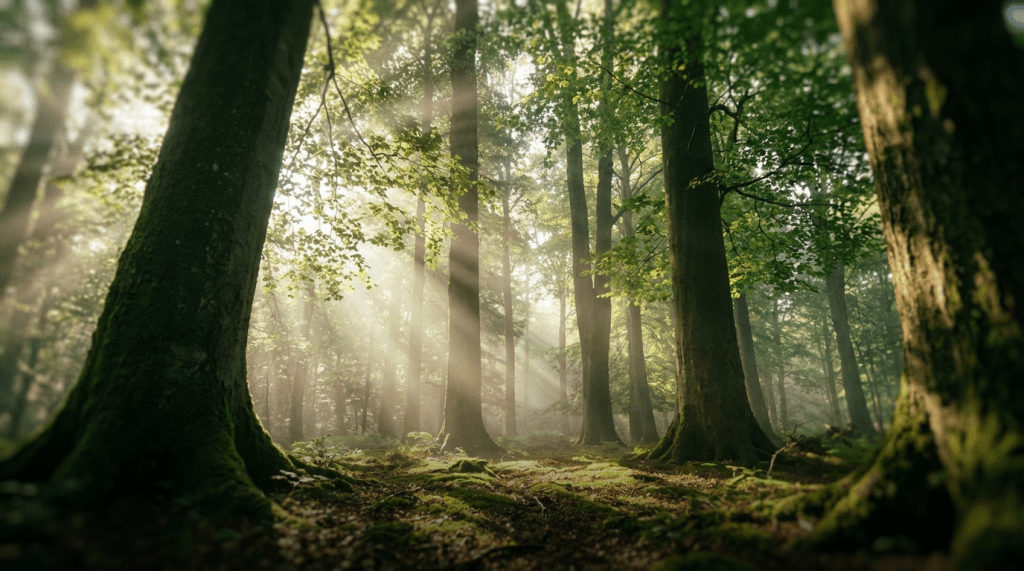
Now take that practice outside, into a wooded area, and something measurable changes.
Japanese researchers coined the term “shinrin-yoku” (forest bathing) in the 1980s, and since then, a substantial body of peer-reviewed research has validated what many cultures knew intuitively for centuries. A 2019 systematic review and meta-analysis examined 22 studies and found that in 20 of them, cortisol levels were lower after time spent in forest environments compared to urban settings.
Trees release volatile organic compounds called phytoncides. When you breathe forest air, you’re inhaling these molecules. A study published in the International Journal of Immunopathology and Pharmacology found that phytoncide exposure increases natural killer (NK) cell activity, your immune system’s front line against infection and abnormal cell growth. Separate research on forest bathing trips showed that this NK cell boost lasted more than 30 days after the exposure. The researchers suggested that a single forest visit per month could sustain elevated immune function year-round.
Even the soundscape plays a role. A 2024 meta-analysis confirmed that natural sounds, particularly flowing water and birdsong, reduce heart rate and accelerate physiological recovery from stress more effectively than silence alone.
One Conscious Breath
Eckhart Tolle, in The Power of Now, puts it simply: “One conscious breath in and out is a meditation.” His point isn’t mystical. When you direct your full attention to a single breath, your mind can’t simultaneously be replaying yesterday’s conflict or rehearsing tomorrow’s problems. You’re pulled into the only moment that actually exists.
He describes breath as an anchor to presence: “Whenever you are conscious of the breath, you are absolutely present.” That alignment between attention and the physical act of breathing is precisely what activates the parasympathetic response. Presence has a measurable signature in your nervous system, and you can see it in heart rate variability data, cortisol levels, and brain wave patterns.
Combine this with being outdoors (bare feet on soil, air that smells like pine or damp earth, no screens competing for your attention) and you’ve created conditions where the mind has very little to cling to except what’s right in front of you. The breath brings you into the present. Nature keeps you there.
A Practice You Can Start Today
Find a park, a trail, a backyard with a few trees. Stand or sit still. Close your eyes if you’re comfortable doing so.
Breathe in through your nose for 4 counts. Hold for 4. Exhale slowly through your mouth for 6 to 8 counts. Repeat for 5 to 10 minutes. Pay attention to what you hear: birds, wind, leaves rustling. Let your breath sync with the pace of the place, not the pace you brought with you.
No equipment, no subscription, no expertise required. Your body and the nearest green space are enough.
What Your Body Already Knows
We’ve spent centuries building environments that keep our stress responses permanently engaged. Climate-controlled boxes, artificial light, constant noise, digital stimulation from waking to sleep. Our nervous systems haven’t adapted to any of it. They still run on the same wiring that evolved in forests, grasslands, and open sky.
Controlled breathing and time among trees aren’t wellness trends. They’re a return to baseline, a way of giving your body the conditions it was built for. Step outside, slow your breathing, and pay attention. Everything else will quiet down on its own.

 Purely Rooted.
Leave a comment